Villain Edit: Edmund Heines
The gay man who was a key figure in the rise of the Nazi party in Germany.


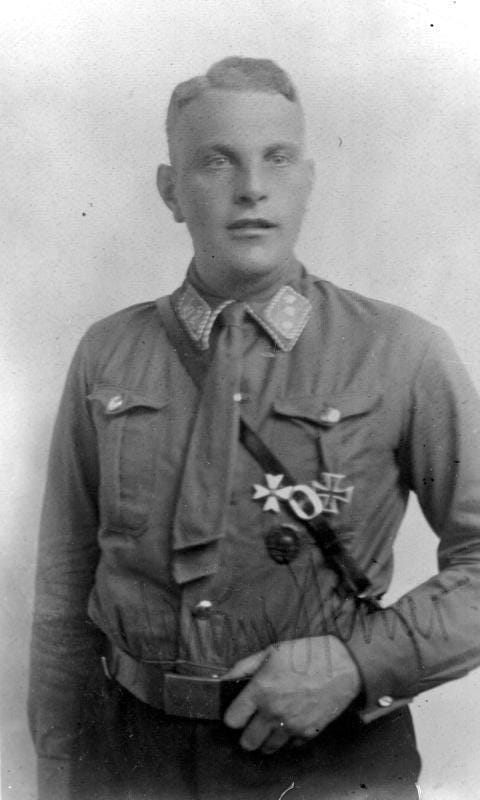
Edmund Heines was a German Nazi politician and deputy to Ernst Röhm.
Heines was one of the earliest members of the Nazi Party and a leading member of the organisation in Munich, participating in the Beer Hall Putsch and becoming a notorious enforcer of the party.
He held several high-ranking positions in the Nazi administration until he was executed during the Night of the Long Knives in June 1934.
Early life
Heines was born in 1897 in Munich.
In 1915, Heines joined the Bavarian Army to fight in World War I. He fought on the Western Front as a field artillery operator, suffering a serious head wound.
Political career
After the war, Heines became involved in the Freikorps movement. From 1919 to December, 1922, Heines served as leader of a unit in Freikorps Roßbach that fought in West Prussia and the Baltic States under Gerhard Roßbach. In March 1920, Heines participated in the Kapp Putsch, and - like most participating Freikorps Roßbach members - relocated to the Mecklenburg-Pomerania area after the coup's failure.
In July 1920, Heines was involved in the murder of Willi Schmidt, a 20-year-old farm worker who allegedly wanted to reveal hidden arms caches of the Freikorps.
Heines returned to Munich following Schmidt's murder, and in 1922 became Führer of the Munich Ortsgruppe, the local Freikorps Roßbach group.
In December 1922, Heines became Member #78 of the National Socialist German Workers' Party (NSDAP), and transferred the Ortsgruppe to the Sturmabteilung (SA), the paramilitary wing of the party.
Heines was appointed leader of the Second Battalion in the Munich SA Regiment and soon became one of the SA's leading members.
In November 1923, Heines was one of two thousand Nazis that participated in the Beer Hall Putsch, being assigned to take the Hotel Vierjahreszeiten. Heines was sentenced to 15 months imprisonment for his part in the failed coup d'etat and was held, together in the same cell with Adolf Hitler, at Landsberg Prison.
Heines was released prematurely in September 1924 while the SA and NSDAP were both still banned, taking over the leadership of the Second Battalion of the Munich Frontbann Regiment until 1925 when he joined the re-legalised SA and NSDAP.
From 1925 to August 1926, Heines was federal director of the Schilljugend, a right-wing youth organisation founded by Gerhard Roßbach which had become affiliated with the SA and NSDAP.
In 1926, Heines enrolled in Erlangen University to study law, and became a Standartenführer of the SA.
On 22 January 1928, Heines was arrested in Schongau for his involvement in Willi Schmidt's murder in 1920, which was exposed during a blackmail attempt. Heines was transferred to Stettin as the main defendant in the trial for Schmidt's murder. The prosecution demanded the death penalty for Schmidt's murder, but the judgement of the Stettin court was 15 years in prison for manslaughter, later lowered to 5 years. He was released in 1929.
Deputy to Ernst Röhm
On 1 May 1931, Heines was appointed Deputy to SA-Stabschef Ernst Röhm, the effective commander of the SA and a close friend of Hitler.
Heines continued to progress in the organisation and accrue power.
In early 1933, the establishment of Nazi Germany gave Hitler control of the army and all other resources of the country. As a result, Hitler no longer required the disruptive street fighting of the SA so he sought to marginalise the organisation.
As de facto commander of the SA, Röhm was one of the most powerful men in Nazi Germany - as a result, Röhm was considered by Hitler to be one of few people who posed a threat to his leadership.
As deputy to Röhm, Heines was also perceived as a threat.
Death
On 30 June 1934, Heines and many other SA leaders were executed shortly after their arrest during the Night of the Long Knives.
The SS found Heines in bed with an unidentified eighteen-year-old male SA senior troop leader.
Heines was executed by firing squad at Stadelheim Prison. It's assumed that the boy that he was having sex with was also killed.
At least 85 people were killed during the purge.
Hitler identified Heines as one of the principal members of a "small group of elements which were held together through a like disposition" in his Reichstag speech of 13 July 1934.
The term "like disposition" was a direct allusion to the homosexuality of Röhm, Heines, and many of the SA leaders.
In subsequent propaganda, Goebbels emphasised the homosexuality of those murdered during the Night of the Long Knives - justifying the purge as a crackdown on moral turpitude.