Egypt denies entry to gay cruise ship
A clear signal that LGBTQ travellers are not welcome.


On one hand, it's not surprising that Egypt has blocked an Atlantis cruise ship from docking - it's not a country that welcomes LGBTQ people in any respect - but it is interesting as to why the Scarlet Lady is attracting attention.
It's the same ship that was recently denied entry to Turkish waters earlier this week - as highlighted by onboard entertainment, Patti Lupone.
The decision by Egypt appeared to come out of the blue, with passengers informed at the last minute via a note slipped under their cabin doors.
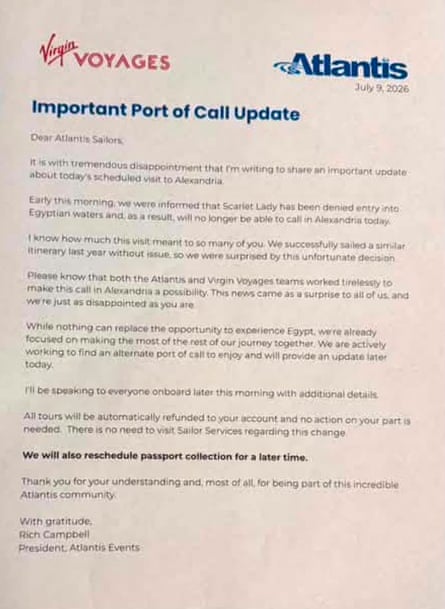
“Early this morning, we were informed that Scarlet Lady has been denied entry into Egyptian waters, and, as a result, will no longer be able to call in Alexandria today,” Rich Campbell, the chief executive of Atlantis Events, the tour group that chartered the Virgin Voyages ship, told passengers. “I know how much this visit meant to so many of you. We successfully sailed a similar itinerary last year without issue. So we were surprised by this unfortunate decision. Please know that both the Atlantis and Virgin Voyages teams worked tirelessly to make this call in Alexandria a possibility. This news came as a surprise to all of us, and we’re just as disappointed as you are.”
It seems that the visit to Egypt was arranged by the cruise operators at the last-minute, as an alternative to the stop-over in Turkey.
Given that both Turkey and Egypt rely heavily on tourism revenue to support their economies, it's a bold move for them to explicitly shut down access to the LGBTQ travel segment.
According to media reports, Atlantis is a cruise company that has been operating for 36 years and this is the first time that one of its cruises has been denied entry to a port. Atlantis is a high profile gay travel brand - frequently presented on social media as a sex-positive space.
The Scarlet Lady will now continue its voyage on to Crete and then Montenegro.
What's life like for LGBTQ people in Egypt?
What's life like for LGBTQ people in Egypt? Let's take a look at some of the key equality indicators.
Is homosexuality legal in Egypt?
While there’s so specific law in Egypt that criminalises homosexuality, the country does have several provisions that criminalise any behaviour or the expression of any idea that is deemed to be immoral, scandalous, or offensive to the teachings of a recognised religious leader.
Egypt is a socially conservative country, and these public morality and public order-based laws are being used against LGBTQ people as well as anyone who supports more liberal attitudes.
In an increasingly hostile environment, it’s being reported by Human Rights Watch that police in Egypt are using dating apps to identify and persecute gay men.
Men interviewed by Human Rights Watch all told similar stories of being arrested on charges of debauchery, prostitution, selling alcohol, or joining a terrorist group. Once in custody, they were subjected to days and sometimes months of abuse such as anal examinations, beatings, rape, and sexual assault.
Are there any protections for LGBTQ people against discrimination?
No.
Is there Marriage Equality?
No. There is no legal recognition of same-sex relationships.
What's life like for LGBTQ people in Egypt?
The public decency laws that are used to persecute queer people began to emerge in the early 1960s. The laws were initially intended to tackle prostitution – they refer to ‘debauchery’ and authorities have interpreted that to include a prohibition on homosexuality.
The systematic crackdown on LGBTQ people appears to have begun around 2000, continuing unabated after the revolution in 2011.
The queer history of Ancient Egypt
Obviously, the existence of queer men and women is nothing new in any part of the world. In Egypt, our recorded history can be traced back to ancient times.
One of the most prominent same-sex relationships of Ancient Egypt is that of Nyankh-Khnum and Khnum-hotep.Nyankh-Khnum and Khnum-hotep lived and served under pharaoh Niuserre during the 5th Dynasty (c. 2494–2345 BC). Both men had families of their own with children and wives, but when Nyankh-Khnum and Khnum-hotep died, they were buried together in the same tomb. In the tomb, several paintings depict both men embracing each other and touching their faces nose-on-nose – in Ancient Egypt, this gesture represented a kiss.
There is little evidence surviving that gives any great insight into LGBTQ life in Ancient Egypt. Any sexually orientated stories recorded in documents or literature are never explicit but use abstract references. No record has been found that indicates any negative views towards homosexuality, or any punishments for same-sex encounters.