Getting Intimate: Legrand Wolf
We go behind-the-scenes of his online life.


I caught up with Legrand Wolf for a behind-the-scenes look at his online life.
What does the changing censorship laws around the world mean for Carnal? Specifically, the UK has recently introduced new restrictions on content that depicts fantasy encounters between family members. Will you need to geo-restrict Carnal content such as Gaycest?
Some places are now trying to make it a crime to publish depictions of sex between people who appear to be close relatives. The rules apply to gay and straight content alike. We follow the law wherever our members live, and I’ll leave the mechanics there.
The people behind these laws are careful to say they have no quarrel with pornography in general. Their concern, they insist, is narrower. They believe this material normalises abuse, and that publishing it tells anyone with those desires that the desires are acceptable. In this telling, the state isn’t censoring anyone. It is simply refusing to feed people’s darkest urges.
It is a theory with a long pedigree and an unbroken record of failure. If depicting a desire endorses it, then Sophocles was running a recruitment drive with Oedipus Rex. Shakespeare owes us an apology for Hamlet’s “incestuous sheets.” The Gideons should be prosecuted for leaving Bibles in hotel nightstands, since the story of Lot and his daughters is right there in Genesis. Nobody believes this, least of all the people writing the laws. Incest has been the raw material of great art since the Greeks. What offends them is the audience. The same subject is literature when it’s staged for scholars and readers, and a crime when two consenting, unrelated adults film it for ordinary people to enjoy at home.
Notice, too, the question these laws never answer: who decides which desires are deviant? Within living memory, a committee of the pious decided what an entire nation could see. Hollywood’s old censorship code banned any hint of “sex perversion,” which meant gay people. It even banned romance between people of different races. Every one of those rules rested on the same theory as the laws trying to criminalise sexual fantasies today: show it, and you’ll spread it. Every one of them now reads as an embarrassment. Furthermore, a fantasy between adults has no victim and, in this case, no relatives. Take those away and the only thing left to prosecute is a thought, which used to be the one thing a free society agreed not to arrest.
Laws against harming children already exist, and they should be enforced. This is something else: the policing of imagination, dressed up as protection.
I’ll finish with this. Every performer at Carnal is a verified adult. Every scene is fiction, and everyone involved knows it. Gaycest is fantasy, the same way a murder mystery is fantasy.
You’ve previously said that the challenges faced by the adult entertainment industry - both privacy and legislative restrictions - could be an opportunity if you’re clear on what your business is and stay focused on that. Are you still feeling optimistic about the business opportunities for Carnal?
Incredibly optimistic. I think we’re at a real turning point, for this industry and for history.
The pressure is real, and much of it lands on our members’ privacy. Age verification laws ask adults to hand over an ID or a face scan to watch something perfectly legal in their own homes. Nobody asks for your passport before you borrow Ulysses from the library, and it was once banned as obscene. That data has to live somewhere, and databases leak; it’s what databases do. A leaked viewing history can cost anyone a job, a marriage or a reputation. In countries where gay love is considered the wrong kind of love, and the wrong kind of love is still a crime, it can cost far more.
So why optimism? Every generation of censors believes it is the last line of defence, and every one of them loses. The Catholic Church kept an Index of Forbidden Books for four centuries, and the printing press won anyway. Anthony Comstock, America’s most famous censor, spent his life trying to keep sex out of the mail, and sex outlived him. Pressure like this clarifies things. It separates the companies that treat members as data points from the companies their members actually trust. We make fantasy-driven gay content, and our members trust us with something deeply personal. Protecting that trust is part of what we offer. The companies that come through this stretch with that trust intact will be in the best position this industry has seen in a generation.
You’ve talked about how Carnal’s mission is to help gay men move past the shame that his holding them back. Is that something that you’ve had to personally navigate?
Yes, and I’d be suspicious of any gay man who said he was done with it.
My shame was taught, and taught deliberately. It came from the Mormon Church I grew up in and from the wider religious culture that agreed with it. In church and outside it, I heard grown men and women say, without the slightest embarrassment, that they saw no difference between homosexuality and murder, rape, bestiality or pedophilia. Tell a child that the deepest truth about him belongs on that list, and he will believe you. I did.
For most of my childhood I believed that if I behaved correctly, God would take my homosexuality away. That is a great many years spent trying to repair something that was never broken.
Coming out didn’t end it; it changed its shape. I still felt I had to be as conventional as possible, with no fantasy that might stray into anything labeled perverted or deviant. My husband and I were living on the good graces of people who had only recently decided our love was something other than deviant behaviour. The unspoken arrangement was that they would accept the love, provided they never had to think about the sex. Tolerance on those terms is a lease, and the landlord can rewrite it whenever he likes. Anyone who has lived on that kind of lease knows the quiet damage it does.
The moment it crystallised came in medical school. I’d started thinking seriously about whether porn could change the world, and whether enough of it could make gay sex as unremarkable as straight sex. My classmates were young and liberal, the last people you’d expect to be prudes. They told me, kindly, that it was fine I was gay, as long as I promised never to do porn. One said porn was disgusting, something only pathetic people did. These were people who watched it, of course.
Hypocrisy about porn has never been confined to the pews, though the pews do lead the league. A Harvard study once found that Utah, the most Mormon state in the country, ranked first in the nation for paid porn subscriptions. States that had amended their constitutions to ban same-sex marriage subscribed slightly more than states that hadn’t.
What struck me most was how selective their disgust was. Nobody at those tables recoiled from a ballerina who wrecked her feet for Tchaikovsky. Using your body until it breaks, in the service of art, earned their admiration. Using your body to make something beautiful that happens to be sexual earned their contempt.
That’s when I understood that the shame is real, and that people who would never set foot in a church are still handing it out.
Religion doesn’t need believers to keep working. It leaves its assumptions behind, and its assumptions about sex are the most durable of all. You can leave the church and still be sitting in its pews. That deserves to be challenged.
I also happen to find it endlessly interesting, which is lucky, since challenging it is my job.
Does the character of Legrand Wolf empower you in your off-screen life? Are you able to tap into the energy of Legrand Wolf even if the cameras aren’t rolling?
Oscar Wilde put it best: “Man is least himself when he talks in his own person. Give him a mask, and he will tell you the truth.” Legrand Wolf is my mask. He’s a constructed character, and I’m not a natural exhibitionist.
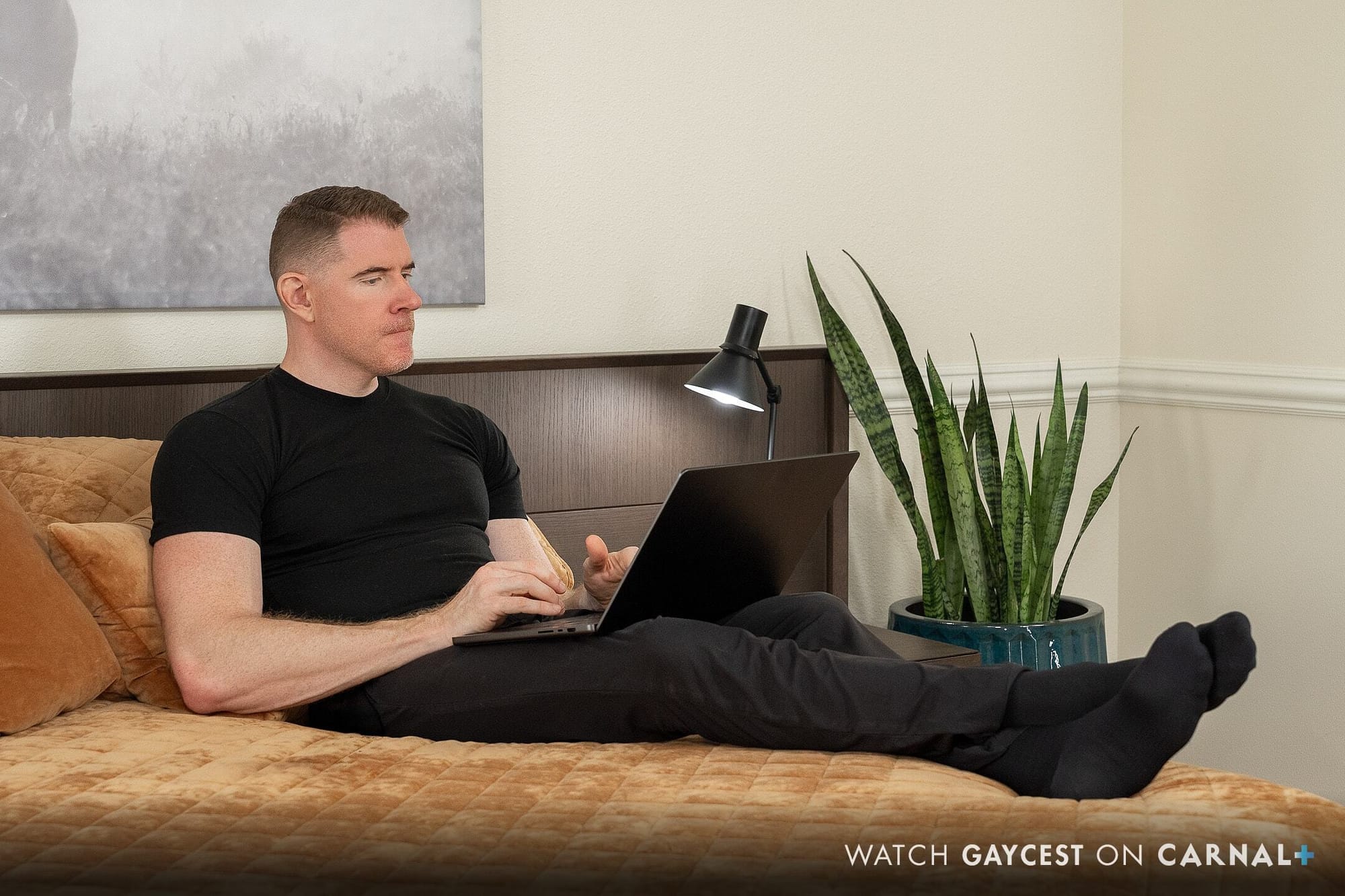
Off camera, I’m closer to an English professor with a naturalist’s leanings, who also happens to like the gym and biohacking: bulletproof coffee, a gym routine, a long day at my desk, a dog at my feet and a book in my library while drinking a few too many cups of tea.
But a good mask is carved from the face underneath it. The first time someone called me daddy, he said I made him feel safe, and I fell in love with the word immediately. That is the part of Legrand I try to carry everywhere: presence, steadiness and care for the people around me. It applies to a scene partner, someone on my team, or my husband at the end of a long day.
Playing him taught me to take up space without apologising, and that habit stays on when the cameras are off.
What’s on your vision-board for the months ahead?
I’m a little too much of a skeptic for vision boards. Though, I have my own version in the form of roadmaps. But if I had one, it would be a quieter thing than people expect.
I want to keep making work I’m proud of, and keep watching the performers we work with grow into exactly who they want to be. The creative and mentorship aspects are still the best part of this job.
Outside work, it’s the small pleasures: My hobbies that I love, the long walks with Jay and the dogs, and a stack of books I keep promising myself I’ll finish.
After everything this industry has thrown at me, I’ve learned to love a boring personal life. Excitement is overrated. Good sourdough bread is not.

 Gareth Johnson