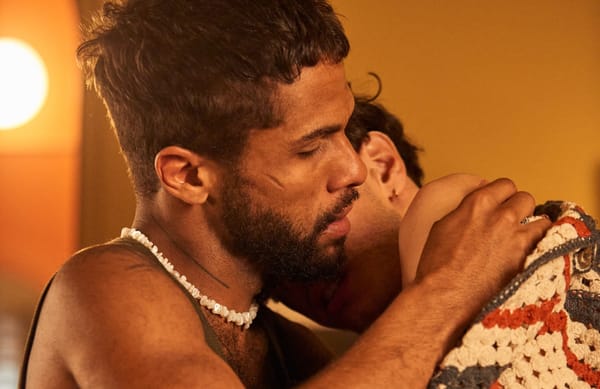
Naked Men Talking: Nick Butler
We go behind-the-scenes of his film, Lunar Sway.

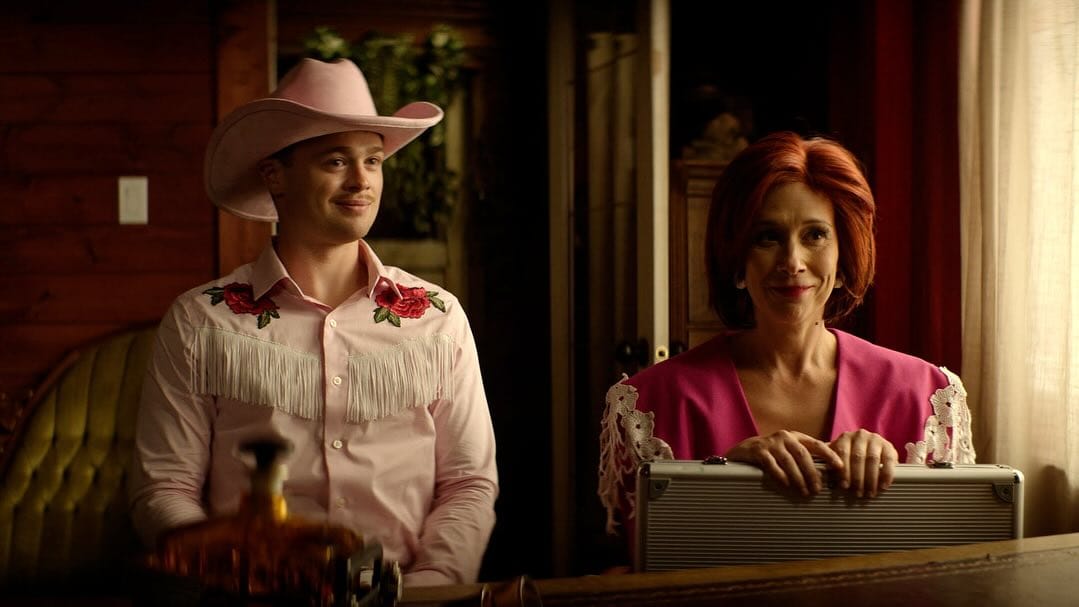
Screening as part of the BFI Flare Festival in London, Lunar Sway is written and directed by filmmaker Nick Butler.
For our podcast, Naked Men Talking, we caught up with Nick Butler for a behind-the-scenes look at the film.
In the conversation, we talk werewolves, hummingbirds, and transactional encounters.
Lunar Sway gives us a story of Cliff, a young man living in a desert town who receives a surprise visit from his con-artist birth mother - chaos ensues. Why was this a story that you wanted to tell?
I had the basic premise in mind for a really long time - what would happen if someone's birth mother came out of the woodwork and all the shenanigans that follow. But I pictured a very different version of the story and it wasn't one that I felt compelled to make at all. It was like a movie someone else could make if they wanted to.
But, then a couple of years ago, I was in an unrequited love situation and this premise kept coming back to me. Something about it was speaking to that moment.
I basically started from scratch, I came up with a brand new protagonist, new setting, new tone and everything - it all kind of flowed from there, being in this unrequited love situation, giving a lot of thought to the idea of looking for love in all the wrong places.
To me, that's what the main character, Cliff's whole journey is about. He's looking for love in all the wrong places and feeling all the humiliation and pain and heartache and everything that comes with that.
Are you saying that it took a darker direction than perhaps you had originally started? A bit more of surreal or hyper-real?
That's a good way putting it. I think that's a big part of the character's journey - he feels quite alienated from the world around him. He doesn't really know what to believe. He's trying to act like he has it all together, but it doesn't feel that way. That kind of captured the essence of what it can feel like to be caught in these crazy, unrequited love situations where your hormones and your heart and your everything else is taking over and it's not always logical.
This movie is set in a weird fictional desert town. The setting was really important to me and a big entry point for me because something about it reflected that feeling as well. It's a very desolate, lonely place on the one hand, but it's also kind of dangerous and exciting and it kind of captures all the range of emotions.
You touched on Cliff's search for love throughout this film - could you talk a little bit about Cliff's sexuality in that context, he's having sex with men and women in this film?
I always thought of him as being bisexual - probably more romantically inclined towards men, most of his serious relationships that are depicted are with men. But I always considered him bisexual. I just intuitively knew I would want the ability for this character to have a romantic relationship with anyone who came across his path - he's willing to give himself away and look for love wherever he can find it, whether it's through physical connection or romantic connection, he's looking for intimacy.
You've said in the notes around the film that you wanted to explore transactional relationships through this story. Is it almost a cautionary tale for queer men about the downsides of the transactional nature of the way that we navigate intimacy in today's world?
Everyone around Cliff is using him in some way or another. He's being ping-ponged around because he's so vulnerable. I think people can pick up on that desperation to find that connection - that leaves you open to being taken advantage of.
When we think of transactional relationships in everyday life, a lot of that's driven by hook-up culture - seeking validation through getting the swipes and the likes and the blocks and the ghosting. There's none of that in this film, but it still somehow feels like a reflection of that in the way that people are using Cliff for their own purposes?
The movie is set in contemporary times but the feel and aesthetic is almost timeless because there's not a lot of technology. They're in this very fringy small town. It isn't directly about modern dating in that way, but I think the spirit of the movie is very much a reflection of modern dating. I've definitely been swiping those apps and I know that whole world a little bit.
Which brings us to hummingbirds? Hummingbirds are a recurring theme - their promiscuity, their inability or unwillingness to form long-term emotional attachments. Is this a bird that you are identifying with?
There's a lot of animal symbolism in the movie.
Hummingbirds represent the idea of multiple romantic partners throughout your life.
I've always been very monogamous by nature and always had this very idealised idea of this happily-ever-after love-of-my-life romance that we all get taught through rom-coms growing up. I was a big rom-com guy as a teen. I definitely bought into all that.
With the passing years, I do find myself struggling to remember why that was ever so important to me. I'm still open to the idea of a serious commitment, but I also question a lot more and I sometimes look back at my relationships and just see the amount of struggle and the ups and downs involved. I'm a lot less idealised than I used to be about the idea of this long-term relationship as the end-goal.
Just because a relationship doesn't last a long time doesn't mean it didn't have a huge impact on my life. Some of my most significant and happiest memories in romantic relationships were not necessarily from the ones that lasted the longest.
What were some of the formative rom-coms?
I grew up on Meg Ryan. I love When Harry Met Sally - that's my comfort movie. I watch that movie over and over.
Does it still hold up?
It holds up so well. They talk about sex a lot which is not common in rom-coms - there's an honesty to it and a frankness and I think that's what makes a good romcom is when you're actually looking at the truth of it, not just the fairytale of it.
You touched on the animal references throughout Lunar Sway. Wolves were another big reference point. Why wolves?
It's exploring what is our animal nature? What's our animal instinct? And exploring the way we kind of go wild under a full moon.
I thought of these characters as stray animals in the desert being swayed by their emotions, their hormones, all of these ulterior subconscious urges that are just their primal animalistic urges.
Again, that stems from that whole mindset I was in when I wrote it of being in this silly illogical unrequited love situation. so I wanted to tap into that.
Were you tempted to make it a werewolf movie?
I love the idea that it's hinting that it's going to be a werewolf movie, but then we never mention it again. I love the audacity of planting that seed and then have it never really pay off.
Posing naked for a portrait painter is a formative experience for Cliff in this film. Is that something that you've ever experienced?
Unfortunately, for better or worse, no. I have an artist friend who did a photography series when I was in my early 20s - I posed in my underwear on the condition that my face would be cut off. In those days, I was very demure in that way. These days, I probably wouldn't care.
It is an important part of the movie. Part of it taps into that idea of objectifying Cliff - this character is constantly being objectified in different ways, which taps into that vulnerability that he has.
What do you hope that people feel when they watch Lunar Sway?
I hope people relate to the universal parts of it. I hope that they see themselves reflected in it, even if the characters are very different from them on a superficial level.
Preview Clip 1
Preview Clip 2
Preview Clip 3
Preview Clip 4