Naked Men Talking: Simon Brandon
The actor takes us behind-the-scenes of Charlie & Striptease, a double-bill of political satire.

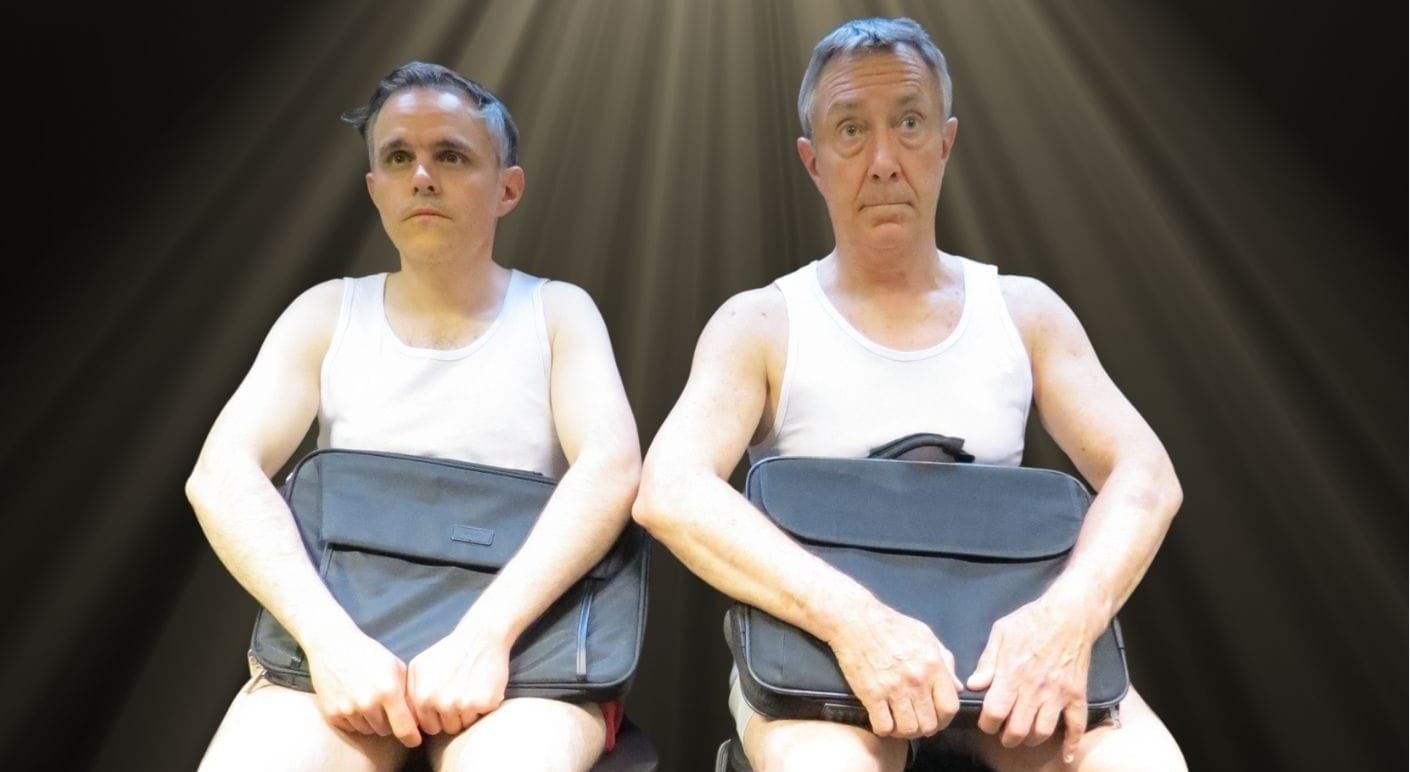
Written by Sławomir Mrożek in the 1960s and 1970s - when Poland was formally part of the Soviet Union - Charlie & Striptease is a double-bill of political satire.
In Charlie, an optician is drawn into a disturbing encounter when an old man and his grandson arrive intent on killing a man named Charlie.
In Striptease, two strangers find themselves unexpectedly in a strange room, dictated to by a mysterious “hand” which requires them to divest items of clothing.
The cast for this production is Rowland D. Hill, Simon Brandon, Kenneth Michaels, and Orsolya Nagy.
Charlie & Striptease will run at the Golden Goose Theatre from 21 April until 9 May
For our podcast, Naked Men Talking, I caught up with Simon Brandon for a behind-the-scenes look at the production.
In the conversation, we talk control, absurdity, and the importance of listening.
This is a double bill of plays from Polish playwright Sławomir Mrożek. In the first play, two men are intent on killing Charlie. In the second play, two men are forced to take their clothes off. Were you familiar with the work of Sławomir Mrożek?
It’s “theatre of the absurd”, which I’ve studied, but this is the first encounter I've had with Mrożek - it's been very eye-opening and very interesting.
These plays were written during the period when Poland was part of the Soviet Union - they're blending social commentary with political satire. Are there any parallels that we can draw with the totally normal geopolitical landscape that we're all currently trying to navigate?
The plays focus on the power of the state and the influence that it has upon the individual. When we look at today, the rights of the individual are always being challenged.
What was Mrożek's perspective on the period that he was immersed in?
From his perspective, individual liberties were being taken away. At that time, intellectuals were seen as a threat - education was seen as a threat. Mrożek used dark humour to highlight the absurdity of all of that but also to provoke questions about how people were being controlled, and to help people realise that they were being controlled even if it was being subtly prodded to do certain things.
That still speaks to us today - particularly in a world of social media and algorithms and monetising every aspect of our lives through putting it all on the internet. We sometimes don't realise the part we're playing in the whole process?
That's right - are we being guided subtly through our day-to-day lives?
How did you discover and start to explore that acting was something that you're passionate about?
I was interested in theatre and TV drama from a very young age, from about five.
What were the formative things that you were watching at that age?
I loved Doctor Who. It was Sylvester McCoy as Dr. Who - that had me gripped. All of these strange worlds and characters, these wonderful, compelling and interesting scenarios - it just filled my head. I saw how actors hold the power to tell stories and to bring characters to life, to make a difference. It just fascinated me.
How did that play out for you?
I did Saturday stage school with Italia Conti. For my A-levels, I studied performing arts. Then, I went to university and studied drama and theatre.
After university, I went to drama school at East 15 and began acting professionally - theatre, TV, films.
What was your relationship with your body like during that time? Were you always comfortable being the centre of attention?
In a way - I think you have to - you can't be timid of your own energy and your own power. You have to realise as a performer that you're moving somebody else in a way that you can see, not in a way that's manipulative, that produces a reaction, but in a way that you've reached them, you've made them think about something.
As a child, I was constantly told that I loved the sound of my own voice. But I have a bit of a love-hate relationship with being the centre of attention - sometimes you want to crawl into a corner because it’s too much.
It's often surprising how many actors and performers are socially quite introverted - the exhibitionism comes out when the spotlight is switched on and they're on the stage and it's go-time. Does that apply to you?
In some respects, yes. But for me, there is a completely different layer - three years ago I was diagnosed as having autism.
How did that change your understanding of yourself?
It helped me realise why I react like I do in certain situations - zoning out or distant or overwhelmed.
I’m more confident in myself since the diagnosis. I’ve got more of an understanding of myself, which give me more self-compassion.
I was interested whether being an actor somehow helps you develop your relationship with your body over time - in that sense of being able to take on different characters, perspectives and see the world through different eyes as you're playing different people. Does that give you different perspectives on yourself in terms of how you look, how other people view you, and how you connect with people?
Yes, it does, in so far as looking through another character's eyes, you can see whether you're not that person. But the danger is to play a character for the two dimensional qualities rather than thinking every character has a truth. As an actor, you have to try and find something likeable about them. Otherwise, you're just playing a two dimensional baddie villain.
Every character has a vulnerability - looking through other characters’ eyes and seeing their perspective helps me to reflect on what are my vulnerabilities?
When it comes to intimacy, does it help you make more authentic connections with people because you get a sense when people are being real and when they're not? Is this person performing for me? Am I performing for this person? Or are we actually having an authentic moment?
Yes, I think so. I think it helps too because you listen for the truth. You listen underneath what's really going on and you can tell when somebody's maybe putting on a mask in a way that is false.
Being an actor allows me to be more aware - aware in my body and in my mind and in my nervous system as to what's going on. I'm trying to have a more deeper understanding of what's going on and the point is empathy - just reading between the lines and taking the time to listen and to not be too focused on one's own challenges in that moment, just to listen to the other person.
That's almost the key to any authentic interaction - to give yourself space to listen to what the other person is actually saying. That comes from basic acting training - you've got to listen to your scene partner before you react, you can't react before they've finished their line. But so many people are bad listeners!
Right - because they're thinking about what they want to say next. You’ve got to be present with the other person.
The second half of this double-bill is a striptease - as the name suggests - two men are being directed to take their clothes off. How much actual nudity are we going to see?
That’s for the audience to find out, but I I may do a few more extra workout sessions in the gym before we open.
What do you hope that people feel when they come to see Charlie & Striptease?
I'd like them to go away understanding that there is more at work in the world than perhaps they’d realised, and also to see how easy one could possibly be manipulated.
The play presents these ideas in a very dark humorous way. There are laughs in the play, but there are also very serious moments and very serious themes.
I hope that people consider those themes and have a good night.
 Gareth Johnson