Naked Men Talking: Ryan Stewart
We talk authenticity, intimacy, and the trauma of reading to children.

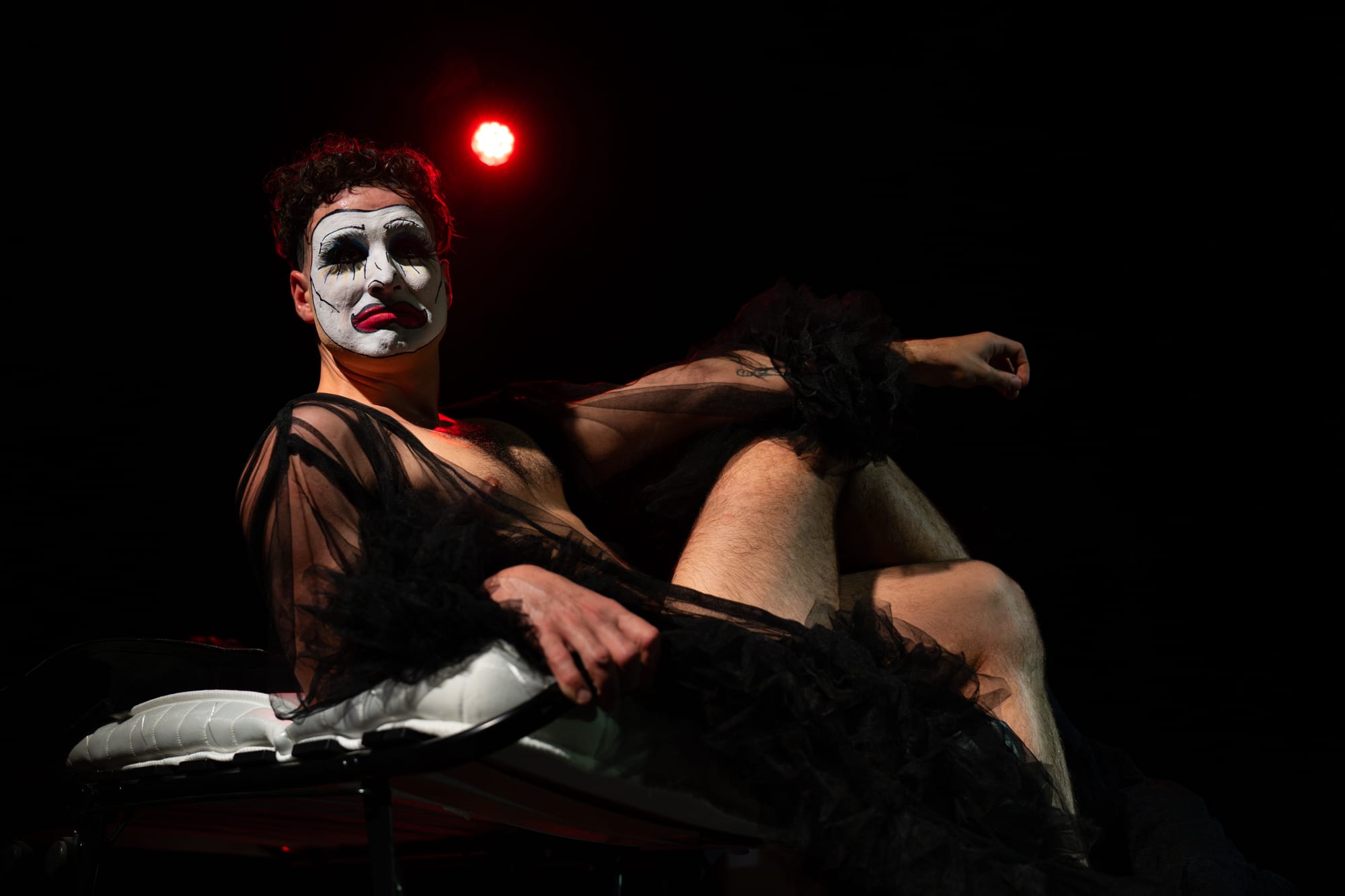
In KINDER, chaos ensues when drag-clown Goody Prostate learns the ‘reading’ they’ve been booked for is actually a children’s story-time hour. Forced to improvise a new act for an unimpressed audience of unruly children and bewildered parents, Goody spirals into a chaotic interrogation of nostalgia and the truth of ‘growing up’.
KINDER will run at Brighton Fringe from 2-7 May - tickets from Lantern Theatre
Ryan Stewart on Naked Men Talking
For our podcast, Naked Men Talking, we caught up with Ryan Stewart for a behind-the-scenes look at KINDER.
In the conversation, we talk authenticity, intimacy, and the trauma of reading to children.
In KINDER, a drag clown is mistakenly booked to perform at a children's story-time, and things spiral from there. What was your inspiration for creating this show?
The thing that really got me onto this specific story of what a drag reading-hour could be was a conversation with a friend where we were discussing the different ways that different communities use the phrase "reading" and the implications of a drag queen misunderstanding what "reading" was.
Especially given all of the discourse that we have at the moment around drag artists and reading hours and moral panic that we're in at the moment.
You're saying that this isn't drawn from your personal trauma of reading to children?
No - probably more from the trauma of being read at as a child because. I was a little bit of a petulant child and always had my nose in a book - the idea of someone else reading to me was always slightly abhorrent.
But - if I was a drag artist - it's about the trauma that would come from realising that you haven't been booked to roast a bunch of other drag queens, you've actually just been booked to read to a bunch of three-year-olds at the local library.
This is a show that you took to Edinburgh Fringe last summer - how has the show evolved over the time that you've been performing it to audiences?
We first staged the show in Melbourne back in 2024. We then toured the show to Adelaide Fringe before taking it to Edinburgh.
We did pretty well at Edinburgh Fringe - got some lovely awards, some great press for the show, which was fantastic.
Now - as we're touring again overseas across May to August - we are back in the rehearsal room and redeveloping it again to take onboard some of the lessons learned, such as cultural references that didn't translate.
What countries are you heading to?
After Brighton Fringe in the UK, we're heading across to Dublin and then over to Prague to do a festival there. We're then looking at a couple more dates in June and July which we are hoping to confirm soon. We're also going back to Edinburgh in August to do a return season.
We'll be on the road for about five months.
You talked about your passion for reading books as you were growing up, and how that helped you navigate your queerness. What was your relationship with your body like when you're growing up?
I was always a very lanky kid. That, tied with this sort of bookishness and this nerdy kind of demeanour that I had when I was a kid, really didn't set me up for the best relationship with body stuff - particularly where masculinity is concerned.
Moving into performance and theatre and being an actor, you start to find roles and ways of presenting yourself and your body that is a lot more congruent with how you feel about it in your head. It certainly helped reconfigure the relationship with my body.
What was your pathway into starting to explore performing and discovering that that was something you're passionate about?
I moved high schools in year 10. I moved to a new school - it was a boys school that was very progressive.
The school had a really strong theatre and arts programme. I auditioned for the school musical - Into The Woods. I was given the role of the narrator. That's what really unlocked it from there.
You talked about how acting and performing helped you feel more connected to your body. Did it also help you navigate your sexuality and your queer identity?
Acting allows you to adopt roles or personas with the protection that you're just playing a role. It was a way for me to experiment with different personality characteristics or looks with that safety.
That's what helped me start to just feel comfortable with looking at myself and accepting that I was different to everyone else and that was okay.
How did that translate into the way that you experienced intimacy?
It's something that I'm still working through with a therapist, to be honest.
I feel like queer people are very similar to actors because we're often code-switching in a lot of different situations for safety. We learn to navigate the path of least resistance in your day-to-day dealings with people.
You can't put that wall up when you're trying to be authentic and vulnerable with someone - but it's really hard to let that wall down.
Do you consider yourself to be an exhibitionist?
I'm an extroverted introvert, is how I'd put it.
I know when I have to turn it on to network - I have to like act like it looks like I want to be there.
Theatre has these very strict conventions around the act of being watched. The lights come on and that's my cue to come out and do my thing.
I'm not sure if that's unlocked anything in me outside of that context - there's that separation still between being watched in a work setting and then how it feels to be watched outside of that work setting.
What do you hope that people feel when they come to see KINDER?
I just want everyone who comes to have a good time and realise that we're all just doing the best we can with what we have at the moment.
I want people to know that queer people are not out there trying to hurt you - we exist with you and we can all just have a good time.
 Gareth Johnson